Business & Tech Essentials
Cybersecurity Compliance Roadmap CCC: Aramco SACS 002 Documentation in Depth
You fixed the security gaps. Controls are deployed. MFA is enabled. Firewalls are configured.
Now comes the phase many organizations underestimate “Documentation”.
This is where cybersecurity compliance roadmap CCC projects either become audit ready or become delayed for months. Most companies assume technical implementation is enough. Unfortunately, auditors do not certify undocumented controls.
Phase 3 of the Aramco SACS 002 journey focuses on proving that your cybersecurity controls exist, operate correctly, and can be validated through structured evidence.
Right after understanding this, most companies realize one thing — compliance is not quick and doing it without expert direction leads to delays. That is where Aramco CCC Consultancy becomes critical to move fast and avoid costly mistakes.
Why Documentation Matters in Aramco CCC Phase 3
Documentation is where organizations convert technical controls into audit evidence.
For Aramco CCC Phase 3, documentation supports:
- Cybersecurity governance validation
- Evidence collection for auditors
- SACS 002 control mapping
- Third party classification validation
- Audit preparation activities
- Control ownership and accountability
Most failed assessments are not caused by missing controls.
They happen because organizations cannot prove those controls exist.
Documentation becomes your evidence layer.
Phase 3 Documentation Roadmap
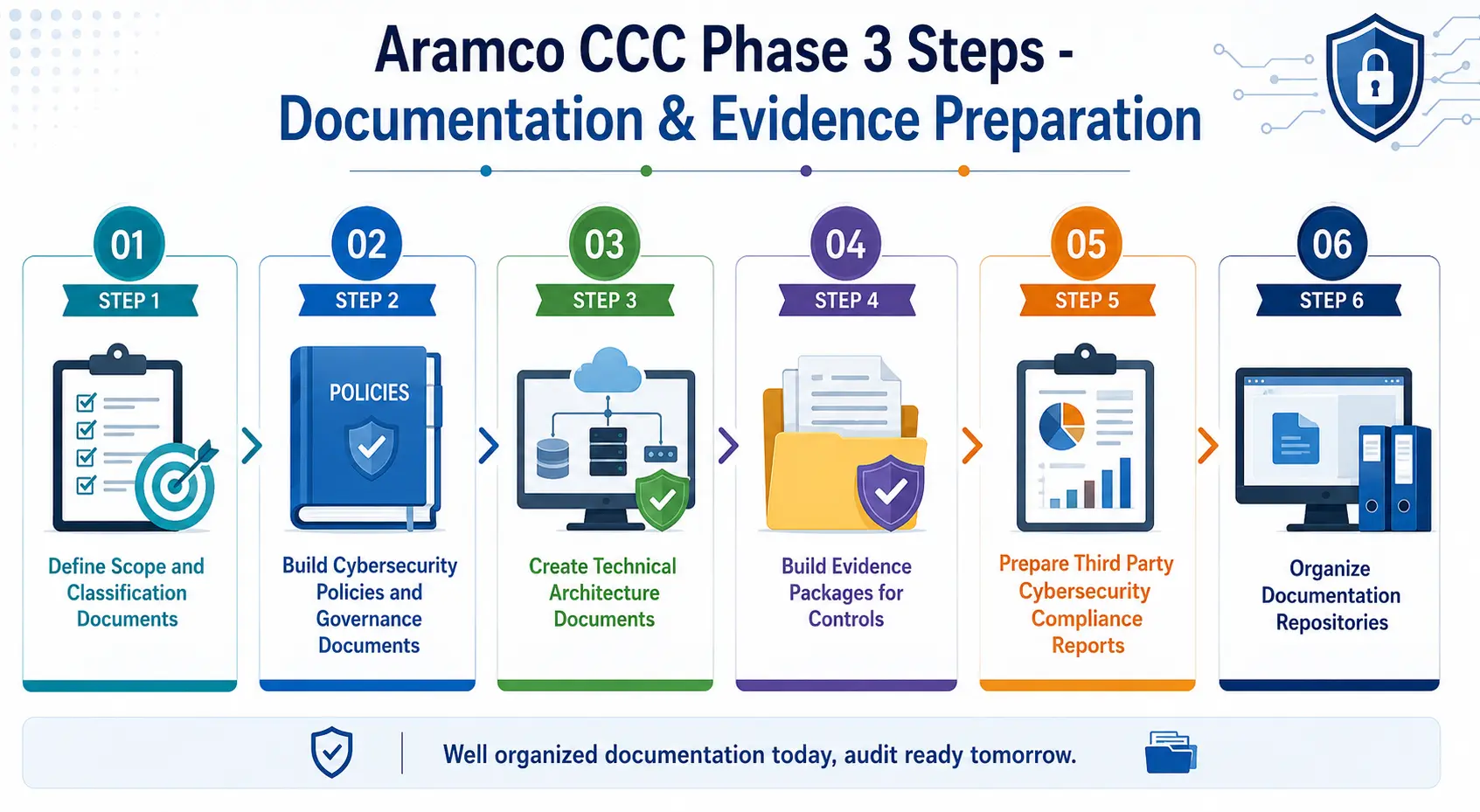
Step 1: Define Scope and Classification Documents
Before writing policies, define scope.
This stage normally includes:
- Third Party Classification Template
- Classification Confirmation Letter
- Asset inventory documentation
- In scope system identification
- Business process mapping
- Environment ownership records
Classification mistakes create documentation problems later in the audit cycle.
Step 2: Build Cybersecurity Policies and Governance Documents
Policies create governance evidence.
Organizations normally prepare:
- Information security policy
- Access control policy
- Password management standards
- Remote access policy
- Incident response policy
- Backup and recovery procedures
- Vendor management policy
- Acceptable use policy
- Change management procedures
- Cloud security procedures
One mistake I frequently see is companies copying templates without customization.
If policies say one thing and systems show another, documentation credibility drops.
Step 3: Create Technical Architecture Documents
Technical documentation normally includes:
- Network topology diagrams
- Data flow diagrams
- Firewall architecture maps
- System inventory sheets
- Cloud architecture diagrams
- VPN connectivity diagrams
- Security tool inventories
Architecture diagrams help prove segmentation and security boundaries.
Step 4: Build Evidence Packages for Controls
Examples include:
|
Control Area |
Typical Evidence |
|---|---|
|
MFA controls |
Configuration screenshots |
|
Access reviews |
User access reports |
|
Patch management |
Update records |
|
Security awareness |
Training reports |
|
Endpoint security |
Antivirus dashboards |
|
Incident response |
Testing records |
|
Backups |
Recovery evidence |
Evidence should be:
- Time stamped
- Clearly labelled
- Readable
- Linked to specific controls
- Stored centrally
Step 5: Prepare Third Party Cybersecurity Compliance Reports
Documentation often includes:
- Company information
- Control descriptions
- Evidence references
- Scope definitions
- Security implementation details
- Exceptions and justifications
- Supporting screenshots
The compliance report acts as the bridge between your internal controls and external verification activities.
Step 6: Organize Documentation Repositories
Compliance Folder Structure Example
- Policies
- Procedures
- Architecture Documents
- Evidence Screenshots
- Training Records
- Access Management
- Incident Records
- Vulnerability Reports
- Audit Evidence
Simple organization reduces evidence retrieval time.
Documentation Checklist for Aramco Vendor Cybersecurity Documentation
Use this checklist before moving to testing activities.
- Classification completed
- Policies approved
- Evidence mapped to controls
- Architecture diagrams prepared
- Compliance report drafted
- Evidence folders organized
- Control owners assigned
- Missing artifacts identified
Common Documentation Mistakes Companies Make
Problem 1 Inconsistent Policies
- Incorrect responsibilities
- Missing scope definitions
- Policy conflicts
Problem 2 Weak Evidence Collection
Many teams save screenshots without timestamps or labels.
Problem 3 Poor Mapping Between Controls and Evidence
Evidence must connect directly to controls.
Problem 4 Documentation Created Too Late
Documentation should evolve alongside implementation.
Expected Deliverables of Phase 3
Organizations should typically have:
- Approved cybersecurity policies
- Architecture diagrams
- Classification documents
- Evidence repositories
- Compliance report drafts
- Control mapping sheets
- Technical documentation packages
Final Thoughts
Phase 3 is where organizations move from technical implementation into evidence-based compliance.
Documentation is not about producing more files.
It is about creating traceable proof that controls exist, operate correctly, and support Aramco cybersecurity expectations.
Documentation alone does not complete the journey. Continue reading the complete cybersecurity compliance roadmap because the next phase focuses on testing, validation, and proving these controls actually work in production environments.
Disclaimer: All logos, trademarks, and brand names used in this document are the property of their respective owners. Their use here is for identification purposes only and does not imply endorsement.
Recent News

AI Agents vs AI Copilots vs AI Chatbots: What Is the Real Difference?
10-09-2026
How to Set Default General Product Posting Groups in Dynamics 365 Business Central
08-09-2026
How to Apply Sensitivity Labels in Power BI for Data Protection
08-09-2026

LEAP 2026 Day 4 Highlights: $15B in Total Investments & The Human Capital Era
04-09-2026

LEAP 2026 Day 3 Highlights: $857M in Tech Deals, VC Growth & Local Manufacturing
03-09-2026

LEAP 2026 Day 2 Highlights: More Than $2.5 Billion Invested to Boost Saudi Arabia's Data Hubs and Digital Capabilities
02-09-2026

LEAP 2026 Day 1 Highlights: $15B+ Investments & 5 Enterprise Tech Trends
01-09-2026
How to Assign Workspace Roles and Permissions in Power BI Service
25-08-2026
How to Set Default Document Line Types in Dynamics 365 Business Central
25-08-2026
How to Create a List Page in Business Central Using AZ AL Dev Tools
19-08-2026

Your choice regarding cookies on this site
Policy, By Continuing, You are agreeing to Our Terms of Use and Consenting to the above.
Privacy Policy Powered By |