Business & Tech Essentials
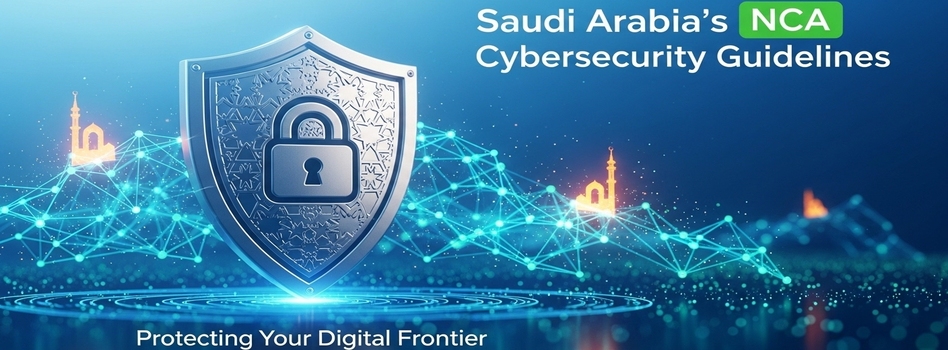
Saudi Arabia's NCA Cybersecurity Guidelines
Overview
Saudi Arabia's National Cybersecurity Authority (NCA) is the government body responsible for setting and enforcing cybersecurity standards across public and private sectors. Established under the Council of Ministers, the NCA operates as the national reference authority on all cybersecurity matters, directly aligned with the goals of Saudi Vision 2030.
Its regulatory documents — binding controls, implementation guides, and sector-specific guidelines — have expanded significantly in recent years. As of 2026, compliance is no longer limited to government entities; private sector organizations of all sizes now fall under mandatory NCA frameworks.
This whitepaper provides a concise overview of the core NCA frameworks and practical steps organizations need to take to comply.
This Whitepaper Document is Generated for information purpose only and for any latest Guidelines users are advised to visit respective sources.
Core NCA Frameworks at a Glance
|
Framework |
Full Name |
Who It Applies To |
What It Covers |
|
ECC 2:2024 |
Essential Cybersecurity Controls |
Govt & CNI entities |
Foundational controls across governance, defense, resilience, and third-party security — 4 domains, 100+ controls. |
|
DCC-1:2022 |
Data Cybersecurity Controls |
All NCA-regulated orgs |
Data lifecycle protection: classification, handling, storage, and encryption requirements. |
|
CCC-2:2024 |
Cloud Cybersecurity Controls |
CSPs and cloud tenants |
Cloud-specific security architecture, data localization rules, and disaster recovery standards. |
|
CSCC |
Critical Systems Cybersecurity Controls |
High-criticality systems |
32 specialized controls for systems where failure could impact national security or the economy. |
|
OTCC-1:2022 |
Operational Technology Controls |
Industrial & OT environments |
ICS/OT security aligned with international standards — covers factories, utilities, and critical infrastructure. |
|
NCNICC-1:2025 |
Non-Critical NII Controls |
All private sector companies |
Two-tier framework: Class A (large enterprises) and Class B (SMEs) with scaled mandatory requirements. |
Note: NCNICC-1:2025 was released in January 2026 and effectively extends NCA's mandatory reach to every private-sector company operating in Saudi Arabia, regardless of whether they are designated as Critical National Infrastructure (CNI).
What's New in 2026
ECC 2:2024 — Updated Foundational Controls
The most significant recent update is ECC 2:2024, which replaces the original 2018 version. Key changes include:
- Cybersecurity Saudization: All cybersecurity roles must now be filled by qualified Saudi nationals — expanded from previous versions that only applied this to senior positions.
- Data localization responsibility has shifted to the National Data Management Office (NDMO), with CCC-2:2024 updated accordingly.
- Structure refined to 4 domains, 28 subdomains, and approximately 110 controls — streamlined compared to the previous version.
NCNICC-1:2025 — Private Sector Now Covered
Perhaps the biggest regulatory shift: the NCA now requires all private companies to meet baseline cybersecurity controls, not just those managing critical infrastructure.
- Class A (Large): Organizations with 250+ employees or SAR 200 million+ in revenue. Independent audits are mandatory.
- Class B (SME): Smaller organizations with scaled requirements. Audits are recommended but not mandatory.
- Both tiers must implement MFA, data encryption, regular backups, and incident logging as a minimum.
Sector-Specific Guidelines
Beyond the core binding controls, the NCA issues non-mandatory best practice guidelines for specific industries and use cases. These are designed to address risks in emerging technology areas:
- E-Commerce Security: Two separate guidelines developed with the Saudi E-Commerce Council — one for service providers and platforms, one for consumers.
- IoT Security: Recommendations for manufacturers and organizations using connected devices to reduce attack surface.
- Telework Controls: Specific guidance for securing remote work environments, including VPN, endpoint security, and access management.
- Social Media Security: Controls for managing organizational social media accounts — covering authentication, access, and content risks.
These guidelines, while not legally binding, are referenced during NCA audits and are considered good-faith evidence of a mature security posture.
Compliance: Practical Steps for Organizations
Non-compliance with NCA regulations carries penalties of up to SAR 25 million. Beyond fines, a breach resulting from non-compliance can result in operational shutdowns and reputational damage. Below is a simplified compliance roadmap.
|
S/No |
Step |
What to Do |
|
1 |
Gap Analysis |
Run a gap analysis against the NCA compliance checklist. Identify which controls are missing or partially implemented and prioritize them by risk. |
|
2 |
Governance Setup |
Appoint a dedicated cybersecurity officer (CISO) or team. Develop a formal cybersecurity policy and strategy aligned with the applicable NCA framework (ECC or NCNICC). |
|
3 |
Asset & Risk Management |
Inventory all IT assets and data. Classify information by sensitivity. Maintain a risk register and conduct regular risk assessments. |
|
4 |
Technical Controls |
Implement mandatory technical safeguards: multi-factor authentication (MFA), data encryption, access controls (least privilege), regular patching, and automated backups. |
|
5 |
Monitoring & Response |
Deploy continuous monitoring (SIEM or equivalent). Develop and test an incident response plan. Report significant cyber incidents to the NCA within 72 hours as required. |
|
6 |
Training |
Conduct regular cybersecurity awareness training for all staff. Maintain training records — this is reviewed during audits. |
|
7 |
Vendor & Audit Readiness |
Extend security requirements to third-party vendors. Schedule periodic internal and external audits. Class A organizations must conduct independent audits. |
Why NCA Compliance Matters
NCA compliance goes beyond avoiding fines — it builds trust with government clients, partners, and international counterparts. In a market driven by Vision 2030, cybersecurity is a basic entry requirement, not an option.
Official NCA Resources
- ECC 2:2024 Implementation Guide: Step-by-step compliance guidance.
- NCA Compliance Checklist: Covers MFA, encryption, patching, and logging.
- Assessment Tools: Self-assessment platforms for measuring compliance posture.
- NCA Incident Reporting Portal: Mandatory channel for incident reporting.
Conclusion
The NCA's 2026 regulatory landscape covers the full spectrum — from foundational controls for government entities (ECC 2:2024) to SME-focused requirements (NCNICC-1:2025). With cybersecurity Saudization now mandatory and private sector coverage expanded, no organization operating in the Kingdom can afford to treat these frameworks as optional.
The key is to start with a gap analysis, assign clear ownership, and build compliance into day-to-day operations — not just documentation. The NCA has provided the tools; organizations need to act.
Recent News
How to Set G/L Account as Default Line Type in Dynamics 365 Business Central
26-04-2026

How to Set Default Dimensions for GL Accounts in D365 Business Central
21-04-2026

Microsoft Copilot in Depth: Features, Use Cases, and Business Impact (2026)
19-04-2026

Steps to Manage Data Source Permissions for APIs in Power BI Desktop and Service
19-04-2026

Sending Alerts Using Power Automate in SharePoint (Step-by-Step Guide)
13-04-2026
%20in%20Brief.webp)
AI (Artificial Intelligence) in Brief
08-04-2026

How to Post a Batch in Purchase Orders in D365 Business Central
06-04-2026
How to Manage User Permissions in a SharePoint Document Library
29-03-2026
Microsoft Power BI Gateway: A Professional Guide
16-03-2026

Benchmarking Discount Voucher Practices: 2026 Industry Guide
16-03-2026

Your choice regarding cookies on this site
Policy, By Continuing, You are agreeing to Our Terms of Use and Consenting to the above.
Privacy Policy Powered By |